Picking the wrong AV integrator in Bangalore is one of the most expensive procurement mistakes a business can make. A bad AV integration project does not just cost you the project budget — it costs you 18 months of meeting room downtime, repeated reactive support calls, missing warranty coverage, and eventually a full rip-and-replace at 2x the original cost.
The good news: you can almost always tell a good AV integrator from a bad one in the first proposal meeting. You just need to ask the right questions. This guide walks through exactly how to choose an AV integrator in Bangalore in 2026 — the 12 essential questions to ask before signing the contract, the red flags to walk away from, and how to verify the integrator’s claims independently.
If you are still in the early scoping phase, start with our AV integration cost in Bangalore guide first to set realistic budget expectations.
Why the Choice of AV Integrator Matters More Than the Brand
It is tempting to focus the entire procurement decision on the brand — “should we go with Logitech or Poly?” — but the integrator matters more than the hardware brand for one simple reason: the same Logitech Rally Bar installed by two different integrators produces wildly different outcomes 18 months in.
The integrator controls everything that determines real-world uptime: room acoustics, microphone placement, cable management, network configuration, ongoing firmware updates, spare parts logistics, and on-site response time. The hardware is a small piece. The integrator’s process, certifications, and AMC quality are the rest.
A reliable Bangalore AV integration company with average hardware will outperform an unreliable one with premium hardware every time.
The 12 Questions to Ask Before You Sign the Contract
Q1. How many years have you been in the AV integration business in India?
Why ask: Experience filters out fly-by-night vendors. AV integration is a long-cycle business — anyone serious has been in it for 5+ years.
Good answer: 10+ years in business, with multiple Bangalore client references they can name on the spot.
Red flag: “We are a startup” with no proof of past projects, or vague answers about how long they have been doing this.
Q2. Are you an authorised partner for the brands you are proposing?
Why ask: Authorised partners get OEM-direct pricing, valid warranties, certified technical support, and firmware update access. Grey-market hardware looks identical at quote stage and fails differently 12 months in.
Good answer: They show you authorised partner certificates from Samsung, LG, Logitech, Poly, Yealink, Crestron, and others. Ask to see them.
Red flag: Vague “we work with these brands” claims without certificate proof.
Q3. Can you show me 3 reference installations similar to my project?
Why ask: Real, recent reference installations validate capability. A portfolio of “case studies” is not the same as references you can call.
Good answer: 3 specific Bangalore references with similar room types, similar brands, and similar budget bands — and the integrator is happy for you to call those clients directly.
Red flag: Generic portfolio brochure with no names you can contact.
Q4. Who does the actual installation — your in-house team or a subcontractor?
Why ask: Subcontracted installations mean quality variance and no accountability. The integrator who quoted is not the one swinging the screwdriver.
Good answer: In-house installation team, with named project manager assigned to your project.
Red flag: “We have partners who do that” — translation: someone else, you do not know who, will install your ₹30 lakh boardroom.
Q5. What is included in your standard AMC (Annual Maintenance Contract)?
Why ask: AMC is where the integrator either earns your long-term business or quietly disappears. The scope of AMC determines your real-world uptime for the next 3–5 years.
Good answer: Documented scope: quarterly preventive maintenance visits, defined SLA, firmware updates, parts included or transparent parts pricing, dedicated support contact.
Red flag: “We will figure out AMC after installation” — by then your leverage is gone.
Q6. What is the response time SLA on AMC?
Why ask: Boardroom down for 2 hours during a quarterly review costs different money than boardroom down for 2 days.
Good answer: A documented SLA — for example, 4-hour response, 24-hour resolution for critical issues; 8-hour response, 48-hour resolution for non-critical.
Red flag: “Same day” with no documentation, or response times that are not in the AMC contract.
Q7. How do you handle out-of-warranty hardware replacements?
Why ask: Year 3+ failures are real costs. The integrator’s process for replacement determines whether you have a 3-day or 3-week downtime when a display dies.
Good answer: Spare stock kept locally in Bangalore, transparent replacement pricing list, agreed turnaround time for swaps.
Red flag: “We will source it when needed” — meaning weeks of waiting and surprise pricing.
Q8. What is your project management process from PO to handover?
Why ask: Process equals predictability. A documented project process means fewer surprises.
Good answer: Named project manager, weekly status updates, defined milestones (site survey → design sign-off → material delivery → installation → commissioning → user training → handover), formal sign-off process.
Red flag: No PM assigned, no documented milestones, “we will manage it.”
Q9. Do you have certified engineers for Crestron, Q-SYS, Extron, or Biamp?
Why ask: Programming-heavy AV systems (large boardrooms, training rooms, auditoriums) require platform-certified engineers. Uncertified work voids warranty support.
Good answer: Named engineers with AVIXA CTS (Certified Technology Specialist), Crestron Master Programmer, or Q-SYS Cinema certification. Ask to see certificates.
Red flag: “We can manage it” without specific named certifications.
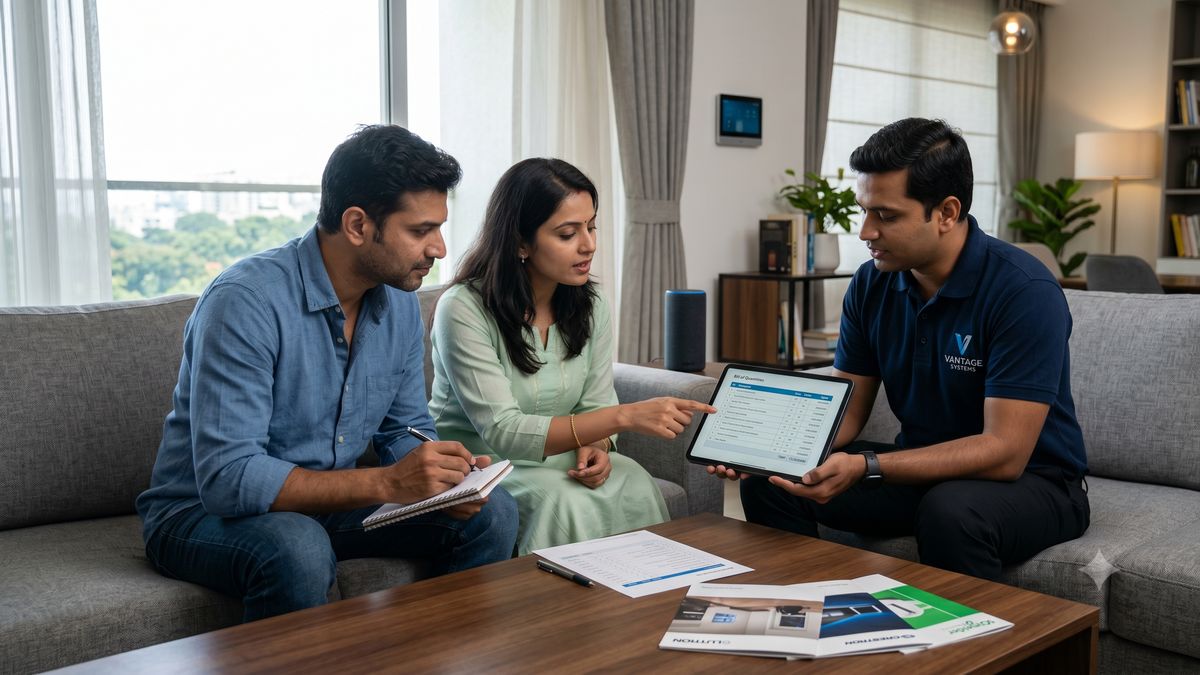
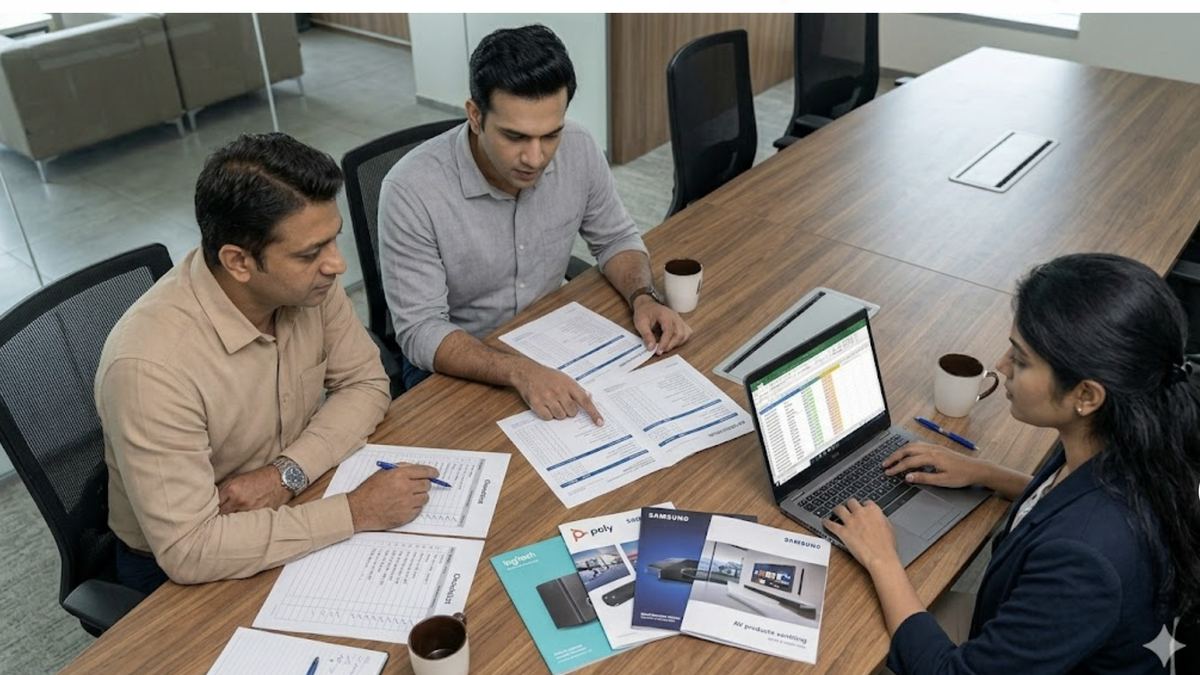
Q10. Can you provide a detailed line-item BoQ with brand and exact model numbers?
Why ask: Bait-and-switch is one of the most common AV integration scams in India — quote a Logitech Rally Bar, install a generic clone, charge Logitech pricing.
Good answer: A BoQ with exact model numbers (e.g. “Logitech Rally Bar — Model 960-001327”), OEM part numbers, transparent unit pricing, optional add-ons separately itemised.
Red flag: Generic descriptions (“Premium video bar,” “Commercial display”), no model numbers, bundled “package” pricing with no breakdown.
Q11. What is your payment structure?
Why ask: Payment terms reveal a lot about an integrator’s financial health and confidence.
Good answer: Staged payments — typically 30% on PO, 50–60% on material delivery to site, 10–20% on handover and commissioning sign-off.
Red flag: 100% upfront (“we are buying material for you”), or 80%+ before any installation work — both transfer all risk to you.
Q12. What happens if your business closes or changes its model?
Why ask: Your AV system has a 5–7 year lifecycle. The integrator may not.
Good answer: Full documentation handover (BoQ, network diagrams, configuration files, control system source code if applicable) so any other certified integrator can pick up AMC. No proprietary lock-in.
Red flag: Proprietary “managed” systems where only that integrator can service your hardware, or refusal to hand over configuration documentation.
5 Red Flags That Should Make You Walk Away
- Quote that is 30%+ cheaper than the next-lowest bidder. AV hardware has tight margins; a deep undercut almost always means grey-market hardware, missing brand certifications, or cut-corner installation.
- No physical office in Bangalore. If they cannot show you their office, you cannot rely on them for SLA-bound support.
- Refusal to put SLA, AMC scope, or specifications in writing. If it is not in the contract, it does not exist.
- Pushing you toward a single brand without explaining alternatives. Good integrators help you choose; bad ones push what they get the highest commission on.
- No certified engineers on the team for control systems. If you are deploying anything Crestron / Q-SYS / Extron based, uncertified work is non-negotiable.
How to Spot a Lowball “Underquote”
The most common Bangalore AV procurement mistake is going with the cheapest quote — only to discover at installation time that the cheap quote was missing 30–40% of the actual scope.
Signs of an underquote:
- No civil / electrical work line items. A real BoQ includes false ceiling modifications, dedicated power circuits, and PoE network upgrades.
- No structured cabling provision. If Cat6A and HDMI extenders are missing from the BoQ, they will appear as “variation” charges later.
- No commissioning, programming, or training hours costed. A boardroom Crestron build requires 20–40 hours of programming. If that is not in the quote, it is not happening.
- AMC not included or “to be quoted separately.” AMC for the first year should be included in the project quote so you can compare apples to apples.
- Vague “installation” line item. Real installation BoQ shows labour days, engineer day rates, and what is included.
For a realistic baseline against which to evaluate quotes, check our 2026 AV integration cost benchmarks for Bangalore.
How to Verify an AV Integrator’s Claims Independently
- Brand partner certificates: Email the brand’s India office (e.g., Samsung India B2B, Logitech India enterprise) and ask “Is XYZ Integrator your authorised partner?” Brands will confirm in 24–48 hours.
- Microsoft Teams Rooms certified partners: Verify on the Microsoft Teams Rooms partner directory. Certified partners are listed publicly.
- AVIXA CTS-certified engineers: AVIXA maintains a public directory at avixa.org. You can search by city and engineer name.
- GST and Udyam registration: Verify the company’s GSTIN on the GST portal. Confirm Udyam registration for MSME-tier integrators.
- Reference calls: Skip the formal reference letter — actually call 2 of the references they provided. Ask about uptime, response time, and any issues over the past 12 months.
What an AV Integrator Should Ask YOU
The flip side: a good integrator will also ask you a lot of questions in the first meeting. If they are not asking the following, they are not really designing for your needs:
- How many people typically use each room?
- What collaboration platform do you use (Teams / Zoom / Meet)?
- Hybrid vs in-person usage ratio?
- Existing IT infrastructure (network speed, PoE switches, server room)?
- Civil readiness (false ceiling, power circuits, structured cabling)?
- Future scaling plans (more rooms, more sites)?
- Internal capability to support the system day-to-day?
An integrator who quotes without asking these is selling you hardware, not solving your problem.
How to Choose an AV Integrator in Bangalore: FAQ
Q1. What is the most important factor when choosing an AV integrator in Bangalore?
The integrator’s ability to deliver and support the system over a 3–5 year lifecycle — not just the upfront installation. Ask specifically about their AMC scope, response time SLA, in-house engineer certifications, and spare stock availability. Hardware brand matters far less than integrator quality.
Q2. How long should an AV integrator have been in business in India?
For boardroom and enterprise-scale projects, work with integrators that have been in business 7+ years. For smaller huddle room or signage projects, 3–5 years is acceptable provided they can show real references and authorised partner certificates.
Q3. Should I always go with the cheapest AV integrator quote?
No. The cheapest quote is almost always missing 30–40% of the actual scope — civil work, structured cabling, programming hours, commissioning, AMC. Compare quotes line-by-line and ask each integrator to itemise the same scope before deciding. The true lowest-cost integrator is usually the second or third cheapest with a complete BoQ.
Q4. What certifications should an AV integrator have?
Look for AVIXA CTS (Certified Technology Specialist) certifications for engineers, plus brand-specific certifications such as Crestron Master Programmer, Q-SYS Cinema, Biamp Tesira, Microsoft Teams Rooms Certified Partner, and Logitech Authorised Partner. Authorised partner status with Samsung, LG, Logitech, and Poly should be in writing.
Q5. What questions should I ask about AMC before signing?
The 5 essential AMC questions: (1) What is the documented scope of preventive maintenance visits? (2) What is the response time SLA for critical vs non-critical issues? (3) Are spare parts included or billed separately? (4) Is firmware update support included? (5) What is the AMC renewal pricing for years 2–5?
Q6. How do I verify an AV integrator’s brand partner claims?
Email the brand’s India office directly (Samsung India B2B, Logitech India enterprise, HP Poly India, etc.) and ask: “Is XYZ Integrator your authorised partner in Bangalore?” Brands will respond in 24–48 hours. You can also ask the integrator to share their partner certificates as PDF — refusal is a red flag.
Why Bangalore Businesses Choose Vantage Systems
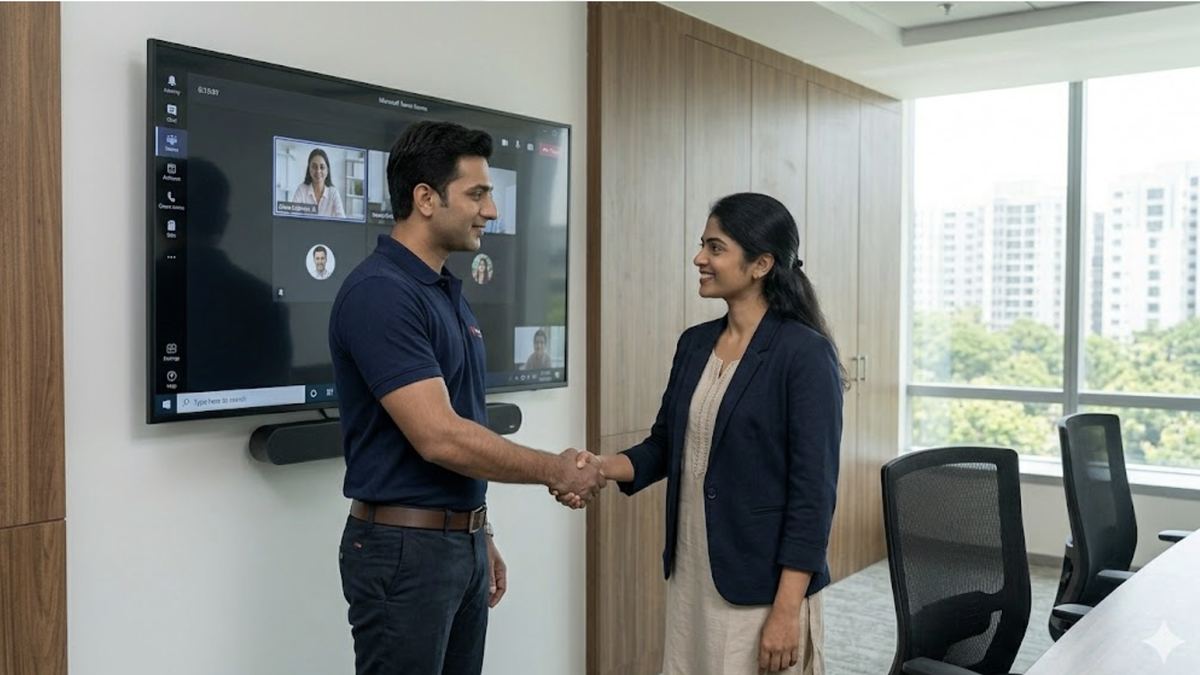
Vantage Systems has been an AV integrator in Bangalore since 1996 — that is nearly three decades of authorised partner status with Samsung, LG, Logitech, Poly, Yealink, Shure, Crestron, and QSC. We have a physical office at Richmond Town, an in-house installation team (no subcontractors), AVIXA CTS and Crestron-certified engineers, and AMC contracts with documented SLAs across IT companies, BFSI firms, manufacturing offices, hotels, and educational institutions across Karnataka.
We are happy to be put through every one of the 12 questions in this guide. Browse our AV solutions portfolio or see the leading AV brands we distribute in India.
Other companion guides for procurement teams scoping AV projects:
- AV integration cost in Bangalore: 2026 buyer’s guide
- Hybrid meeting room AV setup checklist
- Digital signage ROI for Bangalore retail & corporate offices
To get a project proposal that passes every one of the 12 questions above:
- Call: +91 99451 70702
- Email: avsupport@vantagesinc.com
- Visit: 21, Wellington St, Richmond Town, Bengaluru, Karnataka 560025
- Free site survey + line-item BoQ: Request a proposal →